
Hello, hello, hello! Back so soon?
Yes I am, because it’s time for a new FREE-VIEW, my spoiler-free book review series! I know it’s been a while since I did a free-view, but I’m so thrilled to be back.
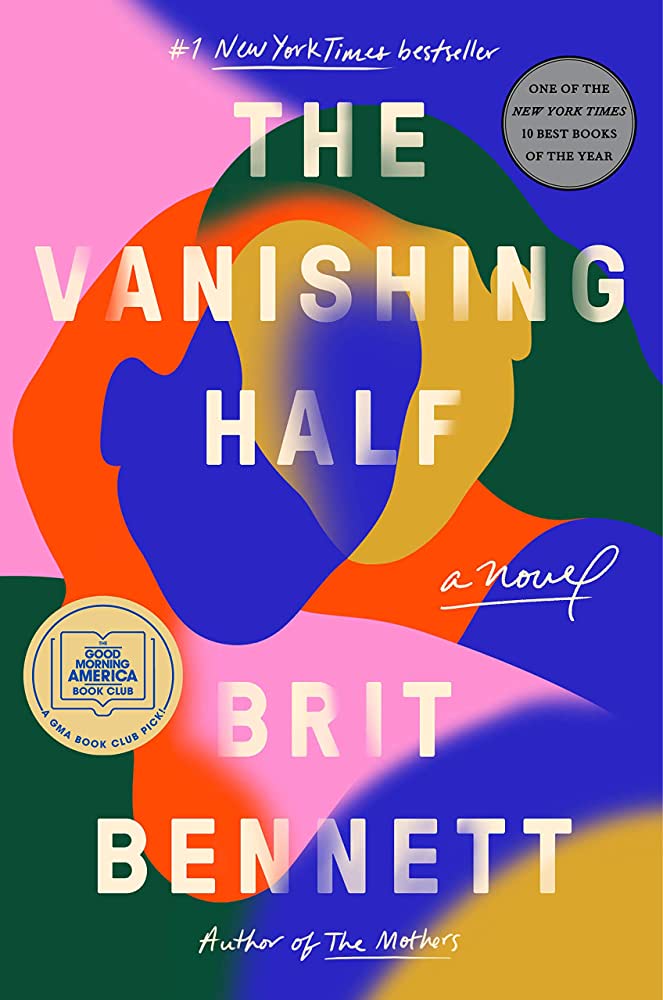
Today on the exam table, we have Brit Bennett’s bestseller The Vanishing Half. Much like the other books I’ve reviewed on readreaming, I’m definitely behind the internet hype when it comes to this book. But fear not! I read it over a year ago, so I was part of the gang, but I wasn’t doing free-views at the time. Better late than never!
Now, if you’ve never read The Vanishing Half, let’s briefly go over what it’s about before I start my TED talk. Two twin sisters, Stella and Desiree Vignes, grew up in a small, Southern town full of fellow light-skinned Black people called Mallard. The twins ran away from Mallard when they were 16, and ended up going their separate ways. Eventually, due to their light skin, Stella is able to pass as a white woman, and chooses to do so, which dramatically changes her life. Meanwhile, Desiree enters a relationship and has a child named Jude, with whom she eventually returns to the town of Mallard. Interestingly, though the twins have long since lost track of one another, their daughters’ lives end up intertwining in a fascinating novel that spans the course of about two decades.
My main takeaway from this book was that I think it’s the type of book in which Black readers may resonate with some of the themes and scenes in a manner that readers of other races cannot understand. While that’s not rare for a book, The Vanishing Half is unique in that it’s the only book I’ve ever read about the phenomenon of passing.
If you don’t know what passing is, essentially, passing is a person’s ability to be seen as a race/ethnicity other than the one they actually are, whether they want to be passing or not. Stella and Desiree do have white ancestry, which contributes to their light skin, but they do also have Black ancestry that is difficult to ignore…unless you’re Stella Vignes.
Stella and Desiree ran away from Mallard in an effort to make something more of their lives. However, the twins took very different paths in life after leaving Mallard. Time upon time, Stella would apply for jobs and be turned down due to her blackness (you may think that’s odd for this day and age, but parts of this story take place in times of extreme racism and prejudice). All it took was one person to assume that Stella was white upon seeing her, and her mind was made up. Stella wanted to be a different person. She wanted to leave her old life behind. That meant she had to be a white woman, so she made every effort to live her life as a white woman.
Desiree, on the other hand, ended up having a child and returning to Mallard (for reasons I will not disclose, because this is a FREE-view!) Mallard isn’t exactly New York City, so Desiree returned to living the quiet life of her childhood and being surrounded by blackness, while Stella did her absolute best to scrub any sign of her blackness out of her life. Eventually, Stella had kids of her own, and the twins lost any and all contact with one another. Where the story gets really interesting is when we start following the lives of Jude, Desiree’s daughter, and Stella’s daughter, Kennedy, and the slow buildup to Stella and Desiree’s eventual reunion as a result.
What makes The Vanishing Half so incredible, in my opinion, is how the concept of passing seems to have gotten flipped on its head in our modern era, especially within the Black community. Back in the 60s and 70s, when Stella decided to pass, as a white woman, lighter-skinned Black people may have felt like that was what they had to do to get ahead. It wasn’t unrealistic in the time, and there have even been movies made about the concept of passing (PASSING, 2021). However, today, I’ve seen plenty of lighter-skinned Black people or multi-racial people try extremely hard to claim their Blackness and embrace it. Culturally, there’s been a renaissance for people embracing their ethnicities/cultures and making their heritage known.
The state of culture in today’s age makes The Vanishing Half such a timely story for me, because Stella and Desiree represent the past and the present/future for me. Stella is the past, the type of Black person who feels like she can’t be both Black and successful. Desiree is the present/future, the type of Black person who doesn’t desire to hide her Blackness, and embraces her dark-skinned children, content with the life her culture has in store for her.
There’s one other topic The Vanishing Half addresses that I think is also timely in today’s age – fetishization. Without getting into too much detail, there are points in the story when Jude, Desiree’s dark-skinned daughter, is sexually fetishized by the very same person who had been tormenting her about her dark skin. This isn’t uncommon, and it goes back to my earlier point about Black readers being able to relate to some of the plot points in this book in a way that other readers cannot. While many other racial groups experience fetishization, what happens to Jude in the story is the clear-cut fetishization and hypersexualization of dark-skinned women, and it’s a phenomenon that has only gotten more prevalent in modern times. The Vanishing Half is one of those special novels set in the past that still have so much to say about the state of our current world and issues of race, fetishization, and culture.
So, in the end, I give Brit Bennett her 10s for creating such a gut-punch of a novel that paints such a clear picture of the past, but is still so relevant in our time. Read The Vanishing Half if you get the opportunity – I highly encourage it!
THE VANISHING HALF by Brit Bennett – Rating: 5/5 Stars

 readreaming